
Shirin Salehi
HUM, HUM, HUM
Shirin Salehi is a visual artist, educator, literary translator and Persian interpreter. Her artistic practice connects drawing, artist’s books, sculpture, printmaking, sound, and poetry, exploring memory, language, and translation. Her work is marked by the near absence of images that opens up space for alternative narratives, where language encounters its own limits, where the voice emerges as a whisper, stammer, murmur, or song and, at the same time, as a refuge from violence and a form of resistance.
Which boundaries define language? What do words articulate, connect, or inevitably leave beyond their reach? Shirin Salehi's practice is situated precisely at this threshold: where language can no longer grasp grief, exile, or violence, and where silence ceases to signify absence and instead becomes a mode of expression and a space we can inhabit together.
Closely tied to both her work as a Persian interpreter for Iranian and Afghan communities and to her own lived experience, Salehi has witnessed how, in moments of profound emotional upheaval, words do not always reach what they long to name. Her own displacement across languages and territories turns translation into a site of loss, negotiation, and transformation. Rather than resolving this impossibility, her work dwells within it. Through a practice marked by the near absence of images and the centrality of writing and sound, she explores alternative ways of engaging what lies beyond discourse. Her texts appear fragmented, veiled, or barely legible; the voice emerges as a whisper, stammer, murmur, or song. Instead of representing a particular experience, her work points towards that which defies representation, shifting our attention to spaces where meaning remains necessarily incomplete.
Leaving the centre blank, Salehi turns instead toward the margins. It is not a matter of abandoning the centre, but of recognizing the power of those liminal spaces where meaning is shaped through interruption and interval. Writing no longer operates as a normative system; it becomes instead a fragile material, traversed by gaps, silences, and gestures that widen the possibilities of language.
Within Salehi's practice, poetry emerges as both a refuge from the many forms of violence and a form of resistance. Fragmentation does not signal something missing, but rather the possibility of constructing alternative narratives where conventional linguistic forms prove insufficient. When the image fails, the word breaks apart, or the narrative is interrupted, gesture, breath, rhythm, and sound emerge as ways of sustaining a memory that cannot be reduced to a linear narrative. In turn, silence –and listening– emerges as a shared practice through which erasure can be resisted and other forms of encounter become possible.
Rather than offering answers, Shirin Salehi’s work invites us to dwell in that space of uncertainty where language encounters its own limits. It does not aspire to say everything or to bring meaning to a close, but to move toward what remains beyond words. Perhaps it is precisely within this threshold, between discourse and silence, that poetry discovers its capacity to resist, to care, and to render imaginable what cannot yet be said.
Shirin Salehi is a visual artist, educator, literary translator, and Persian interpreter working with Iranian and Afghan asylum seekers in Spain. Born in Tehran in 1982, she emigrated to Spain in 1999 and lives in Madrid. Working across drawing, artists’ books, sculpture, printmaking, sound, and poetry, her work explores memory, language, and translation through forms of hiddenness and illegibility.
She teaches at the Center for Book Arts in New York and at LENS School of Visual Arts in Madrid. She has given lectures at the Museo de Málaga, the Centro de Arte Reina Sofía, and the Museo del Prado, and presented performative readings at universities, libraries, among other cultural venues.
She has undertaken residencies at Est-Nord-Est, Quebec (2025), the Academy of Spain in Rome (2021), Fondazione Il Bisonte per la Grafica, Florence (2016), and Casa de Velázquez, Madrid (2014).
Her work has received First Prize from the Ankaria Foundation for Artists’ Books (2015) and the Pilar Juncosa & Sotheby’s Biennial Award for Artistic Creation (2019), awarded by the Miró Mallorca Foundation for a project with Inma Herrera. In 2022, she was nominated for the Queen Sonja Print Award (Norway).
*The title HUM, HUM, HUM works on different levels. Phonetically, it imitates the act of humming with a closed mouth, but the repetition also suggests something collective and, at the same time, fragmented. It both sounds like the physical act of humming and relates conceptually to singing inwardly—as a whisper, an internal gesture of resilience. A song carried inside, without moving the lips; a form of resistance.

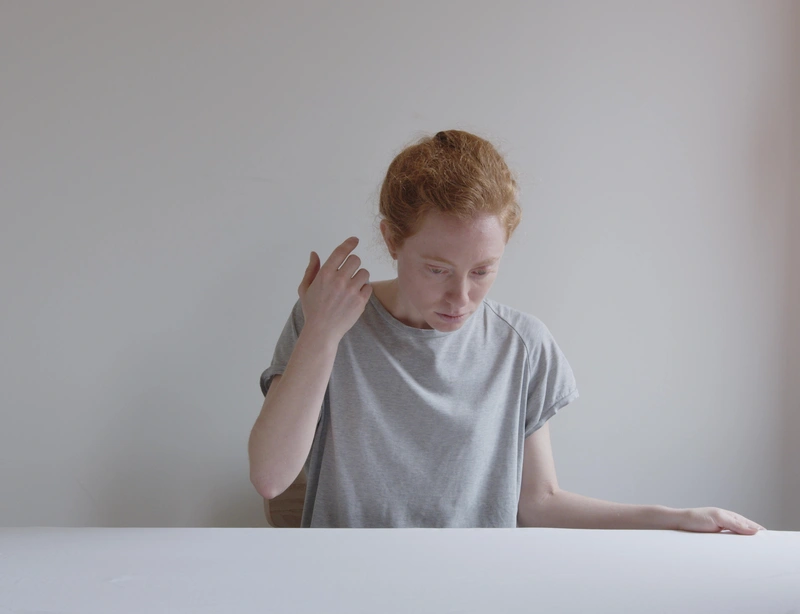
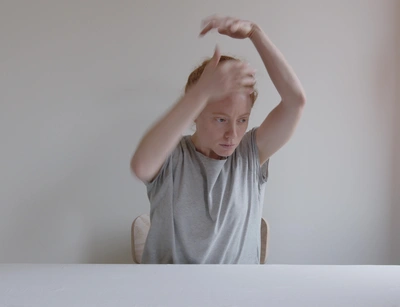
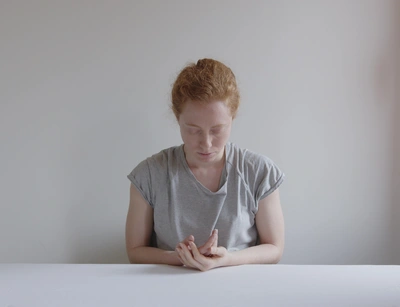
Shirin Salehi, El odivlo no avilia, video, 2025 (video still). Performer: Alicia Narejos.
Photo: artist's archive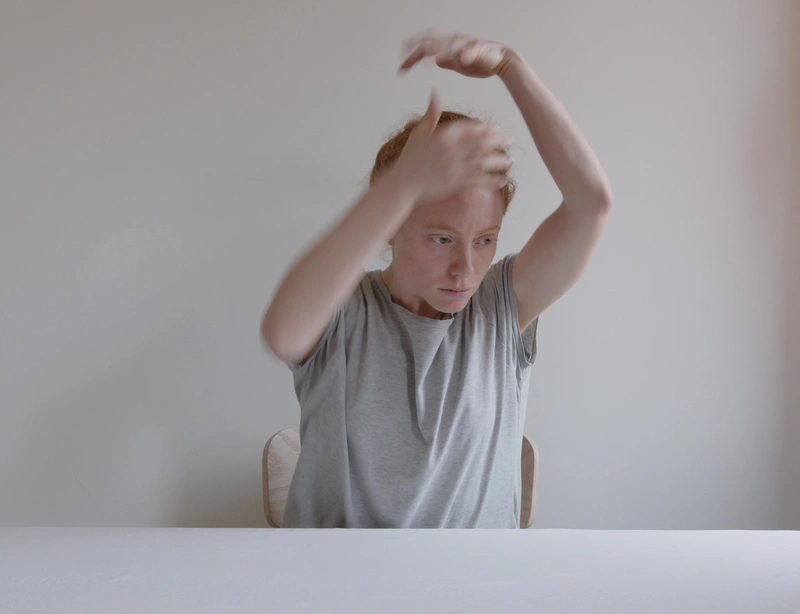
Shirin Salehi, El odivlo no avilia, video, 2025 (video still). Performer: Alicia Narejos.
Photo: artist's archive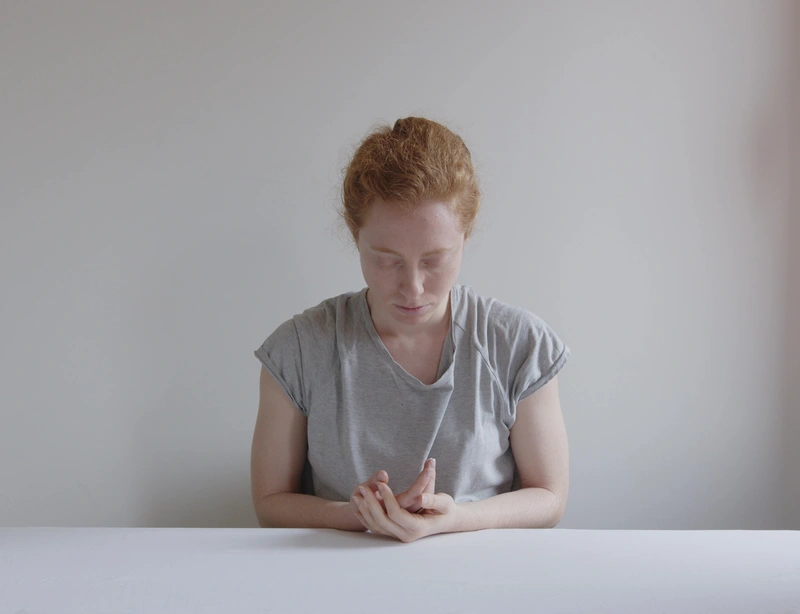
Shirin Salehi, El odivlo no avilia, video, 2025 (video still). Performer: Alicia Narejos.
Photo: artist's archiveProducer of the exhibition: International Centre of Graphic Arts (MGLC)
On its behalf: Nevenka Šivavec
Exhibition curator: LaOtra (María Amador & Patricia Sorroche)
Exhibition coordinator: Dušan Dovč
Production support: Tajda Tomšič
Educational and accompanying programme: Lili Šturm
Public relations: Sanja Kejžar Kladnik
Head of promotion and marketing: Petra Klučar
Logistical support: Tea Stepan
Technical support: Boštjan Vidmar
Authors of the texts: Shirin Salehi, LaOtra (María Amador & Patricia Sorroche)
Editor of the texts: Karla Železnik
Special support: Institut Ramon Llull, AC/E Acción Cultural Española, Tti Bovis Group, Community of Madrid
Acknowledgements: Maria Costafreda, Anna P. Milán, Tanya Morand, Carla Priego, Anne Riesenberg, Pere Quílez
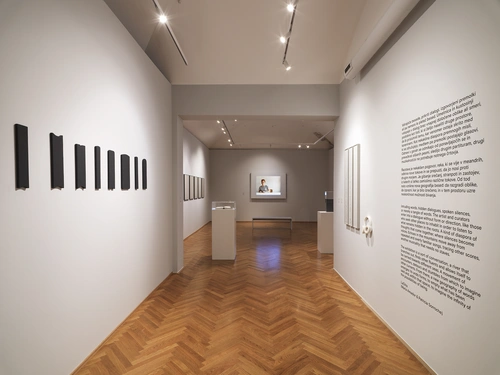
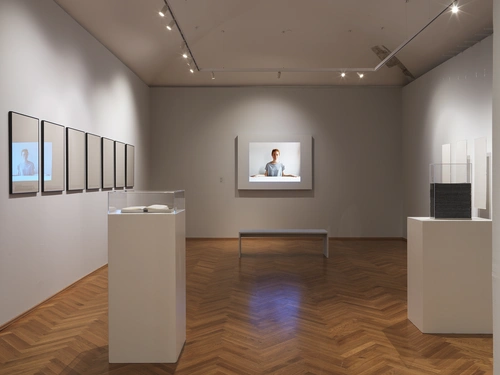
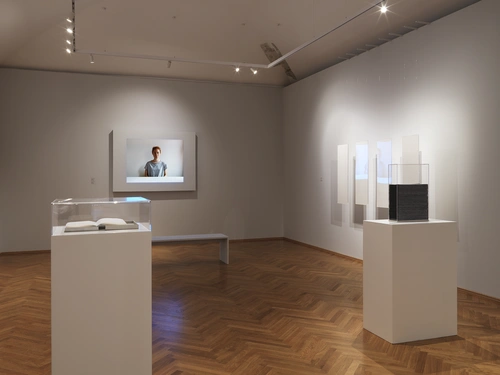
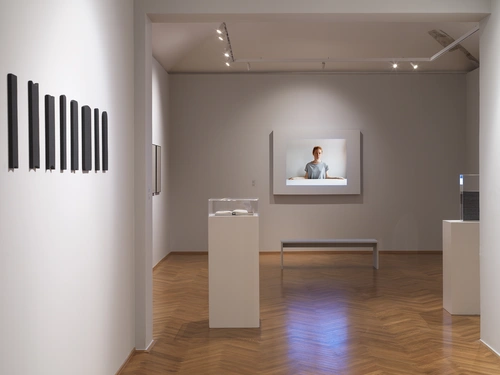
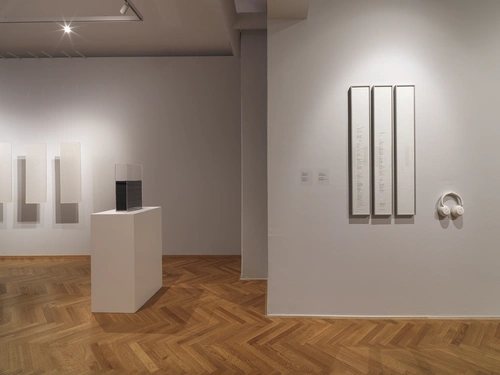
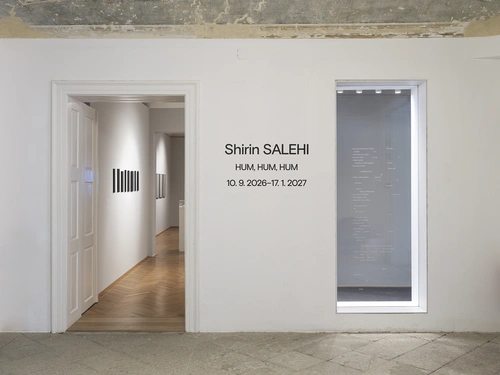
Installation Views
Accompanying programme
Other exhibitions
Currently on view
