
Klara Debeljak
Stone upon Stone, a Palace. Speculative Infrastructures
Thirteen artists are currently working at the MGLC Švicarija creative and residency centre. Their work is presented in the From the Studios series. On this occasion, the presentation marking the conclusion of the two-year Young Artists Residency features Klara Debeljak.
Klara Debeljak works at the intersection of critical theory, visual art and digital practices. During her two-year Young Artists Residency at Švicarija, she examined the parallels between the gentrification of the internet and urban space.
The exhibited found construction parts and structures, screenprints on metal plates, sound installation and theoretical publication are part of the artist’s ongoing exploration and development of the concept of speculative infrastructures, which challenge dominant techno-social systems while envisioning new modes of organisation, ownership and resistance.
Curators: Dušan Dovč and Lara Mejač
Klara Debeljak (1995, Ljubljana) is a researcher and intermedia artist. In 2024, she was selected for the two-year Young Artists Residency programme at the MGLC Švicarija residential and creative centre, where she developed a project exploring the gentrification of digital and urban spheres. Her practice intertwines writing, design, printmaking and video art. While studying Psychology at Charles University in Prague (graduating in 2019), she began exploring digitisation, online intimacy, identity and the changing concept of community from an architectural perspective. In 2023, she graduated in Graphic Design from the Gerrit Rietveld Academie in Amsterdam. She has exhibited in group shows both in Slovenia and internationally. Her writings have been published on the platform Designers Write (Netherlands), by Nero Editions (Italy), in Kajet (Romania) and on the society and culture website Disenz (Slovenia). In 2022, she worked with the ABCND store as part of the UNFAIR programme (Amsterdam), and in 2021, she was one of six designers awarded a podcast and financial grant by the Stimuleringsfonds (Netherlands). As a designer and author, she has collaborated with Street Art News and Nieuw Dakota. Since 2021, she has worked as a researcher at the Institute of Network Cultures (Amsterdam).
The New Life of Urban Ruins
For Klara Debeljak, exploring and experiencing public space began with a daily physical and mental ramble from the arcadia of the city park and Švicarija, where she spent two years on a residency for young artists, into the vortex of the capital that nonetheless retains a distinctly provincial character. This r(amble) may have left a deeper mark on the artist, who studied Psychology in Prague and Graphic Design in Amsterdam, than on us, who remain, in our own way, encapsulated within the contours of Ljubljana. The experience of the liminal, in-between space and a series of dichotomies (between home and the world, natural and artificial landscape, private and public space, temporary and permanent architecture, the real and the speculative, the analogue and the digital, the communal and the privatised, labour and capital, theory and practice) have guided both her research ethos and theoretical discourse. In doing so, she combined critical theory with art, and empirical research with speculation, forming a conglomerate into which she could, through artistic means, incorporate a range of media, from words, generated and manipulated pictures, the moving image and video, to mentoring work, printed matter and do-it-yourself / do-it-with-others publishing projects.
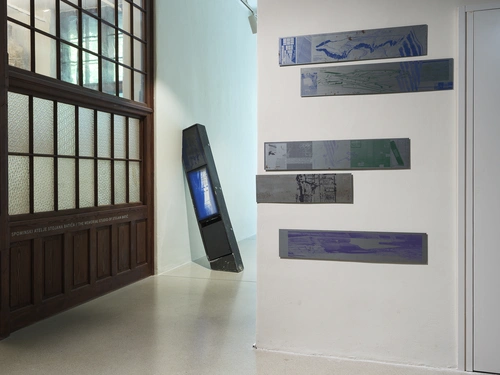
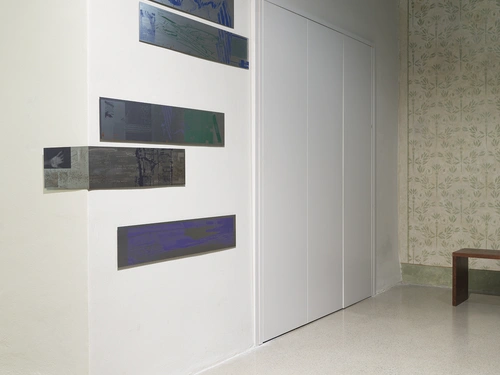
To date, the document as a product of research and theoretical work has occupied a central position in Klara Debeljak’s practice, taking the form of an artwork. In this exhibition, however, it has been deliberately placed ‘behind the scenes’. Condensed into a collection of essays, it appears in the publication Speculative Infrastructures, which offers an immersive reading experience exploring the themes of the gentrification of the internet and urban spaces. The exhibition has transferred the aura of the publication as a research document onto the exhibited objects. A shift has occurred from the immaterial (theoretical, discursive, critical) to the material (objects). As a gatherer, the artist has condensed found waste objects into ruins, into a new material iconography, thereby enabling us to amble from a mental environment to a sculptural metaphor. In doing so, she has supplemented her gathering efforts with printmaking. Stemming from the publication and its focus on the ownership of infrastructures, she has used the algorithms of the digital world as visual points of departure, screenprinting them onto metal plates. Found digital images, data and markers (infrastructure plans, distribution routes, ownership, timelines …) are mirrored onto metal, where the screenprinting ink connects with the reflection of the metal plate. The prints have become a kind of map of the publication’s main conceptual levels and editorial reflections. Their aim is to present positive and alternative initiatives for the circulation and exchange of information and cultural codes.
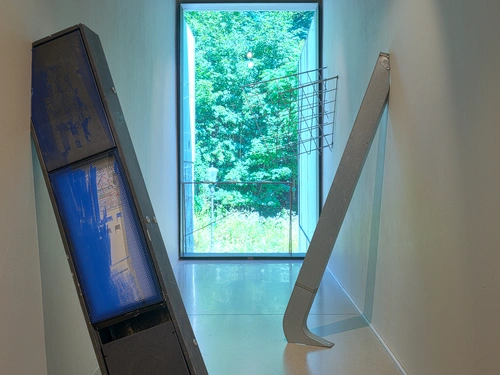
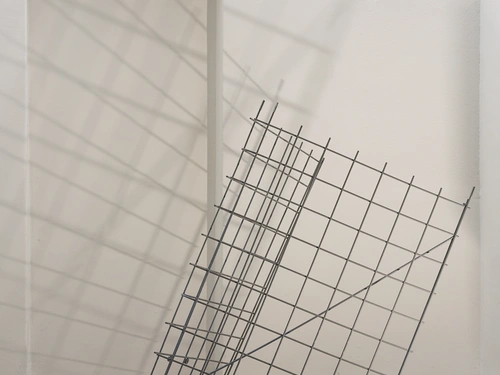
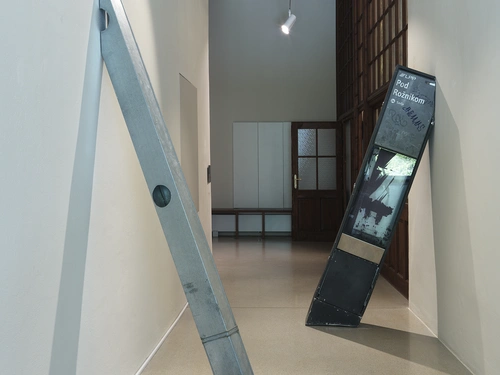
Further, Klara Debeljak not only addresses her position as a theorist and author, but also offers a reflection on the current state of art, sculpture, urbanism, spatial planning and architecture. The aesthetic relationship to the exhibited ruins reveals history as a relationship of power, capital and time. The found and readymade objects are relics of a failed construction investment (metal drainpipe), a by-product of public transport planning (Pod Rožnikom bus stop stand) and a nostalgic object from the socialist era of self-built constructions (reinforcement mesh for concrete, which used to be tied together with metal wire and nails, but is now sold prefabricated in DIY stores).
Klara Debeljak has breathed new life into these constructions and urban ruins, while displacing their centre of gravity. It is as though she has attributed a metaphorical significance of infrastructural transfer to the ruins, recognising in them a particular allure and aesthetic value that wavers on the threshold between the sensual and the artistic. Although her intervention does not involve the manual processing of raw material, but rather the appropriation of a found object, it is still the result of human will. The intervention remains concealed – in fact, the artist has approached the practice of sculpture and object-making as a medium rather than as a form of visual representation. She remains committed to exploring the medium within the medium, distribution, displacement and the mediating role of various mediums. The objects, composed into a spatial installation, inevitably appear at first glance as little more than construction or urban ruin, yet they gradually liberate themselves from their materiality. Through artistic intervention, they acquire the sentimental value of the ‘unreadymade’ – that which signifies more conceptual, open or collaborative creative processes, rather than finished, mass-produced products. As a spatial installation, together with the publication, they contribute to the artist’s initiative – to construct better organisational logics for the future and to cultivate hope beyond the current cynicism, irony and powerlessness.
Dušan Dovč
Grain upon Grain, a Loaf; Stone upon Stone, a Palace
Klara Debeljak works at the intersection of critical theory, visual art and digital practices. During her two-year residency at Švicarija, she explored hidden infrastructures and their speculative potential through her distinctive interdisciplinary approach, drawing parallels between the gentrification of the internet and urban spaces, as well as examining the shifting meaning of community in today’s technology-dependent world.
At a time when algorithms curate every aspect of life and influence the everyday decisions of the average online user, configuring the global political and social landscape and undermining critical thinking, it seems more important than ever to understand how digital infrastructures function and how to harness their operational logic to create alternative modes of coexistence. The point of departure for the artist’s long-term research began with the observation that the displacement of public urban space bears an uncanny resemblance to the current erosion of virtual space. Although at first glance these may appear to be two entirely separate domains, both systems are driven by the same mechanisms – market monopolisation and platform economy, along with the monetisation of all aspects of existence – which are financed by property markets and which fragment along identical axes of capital accumulation and the financial ‘optimisation’ of space.
In this, Klara Debeljak also highlights how individual identity and social engagement are increasingly adapting to the operation of digital infrastructures. As a way of confronting the current situation, which seems utterly hopeless since capital immediately absorbs and appropriates every attempt at change, she proposes the possibility of incorporating speculation and imagination as an alternative framework and establishing different ways of connecting and taking on existing narratives. By redirecting attention to the technical operation and ideological potential of infrastructures that are often deliberately obscured, ranging from urban and energy networks to submarine cables and the data centres of the global internet, she encourages us to try to imagine a different system. The artist sees the greatest potential for change precisely in these speculative – temporary, random, communal, fragmented, ever-changing – structures.
The exhibition Stone upon Stone, a Palace reflects the artist’s research-based approach, critical inquiry and complex understanding of current issues. In her creative process, she frequently collaborates with various agents, thereby interweaving diverse, interdisciplinary perspectives and generating atypical, at times contradictory connections. A publication has also been released to accompany the exhibition, one of the central elements of the project, which brings together diverse perspectives on the theme of speculative infrastructures and further develops its core reflections on the pitfalls, potentials and future of both digital and analogue networks. The contributors to the publication challenge the prevailing techno-social conditions of existence and propose new practices of operation, ownership and resistance, often from within existing systems.
Unusual infrastructural objects emerge within the exhibition space, revealing the mechanisms of the past and the future, while transforming the venue into a conspiratorial hub. Here, visitors attempt to piece together individual elements and reconstruct the investigation at hand through subtle hints, bits of maps, mysterious sound recordings, unknown symbols, fragmented notes and speculative diagrams. In this way, the artist transforms the space into a temporary infrastructure that fosters the exchange of ideas, construction of alternative discourse and different modes of organisation. The connection between the exhibition title and the Slovenian proverb “Grain upon grain, a loaf; stone upon stone, a palace” (Zrno na zrno pogača, kamen na kamen palača) highlights the importance of small steps and seemingly insignificant gestures in forming community and imagining alternative futures. Speculative infrastructures thus do not represent an entirely new system, but rather take shape within the cracks of the existing order, gradually undermining it through mechanisms of mutual support, friendship and solidarity.
Lara Mejač
Speculative Infrastructures, Outposts in Collapsing Realities
The exhibition by Klara Debeljak is complemented by a reader that contextualises contemporary initiatives in publishing, spatial experiments and the development of discourses that shift existing infrastructures.
The authors of the essays in the book are Klara Debeljak (introductory text), Marta Ceccarelli, Morgane Billuart, Lukas Engelhardt, Aljaž Škrlep, Aaron Moulton, FANA'فَِناء and Yasmin Huleileh, Pia Brezavšček as well as !Mediengruppe Bitnik. The interview with Keller Easterling was conducted by Klara Debeljak.
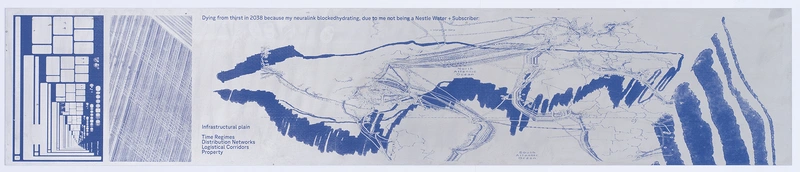
Klara Debeljak, Dying from Thirst, 2026, screenprint on metal plate, 100 x 20 cm.
Photo: Jaka Babnik. Arhiv MGLC.Producer of the exhibition: International Centre of Graphic Arts (MGLC)
On its behalf: Nevenka Šivavec
Exhibition curators: Dušan Dovč in Lara Mejač
Educational and accompanying programme: Lili Šturm
Public relations: Sanja Kejžar Kladnik
Promotion and marketing: Petra Klučar
Design: Anja Delbello, Aljaž Vesel / AA
Installation Views
Accompanying programme
5 p.m.
Švicarija
10 a.m.
Grad Tivoli and Švicarija
11 a.m.
Švicarija
News
Other exhibitions
Currently on view
