
Tracy Naa Koshie Thompson
Worlds within Worlds: Terra Incognita
Tracy Thompson's practice is the culmination of years of experimentation, reverse-engineering and close observation of the plasticity of food polymers and their apparent yet hidden universes.
Thompson's interest in deconstructing foods in their material and pictorial representations emerges as both a critique and an expansion of the still-life genre. The tradition of still-life typically involves pictorial representation of fruits and flowers arranged on a table, or banal objects and personal effects, either painted or drawn, sometimes bearing religious connotations or contemplations of human futility or death (vanitas). Thompson moves beyond the traditional setting of food on a table intended for human consumption, instead experimenting with foods in themselves – such as waakye (rice and beans), fufu, noodles and jollof rice – transforming them into new forms. She does so by paying close attention to lively food material processes such as fermentation, crystallisation, plasticity and other micro-forms and processes that challenge the literal representation of food we are familiar with.
Thompson employs ultra-processing and micrography of foods like kanzo – burnt food scraps that congeal at the base of pans after cooking – a delicacy for some in Ghana. She elevates this seemingly banal residue as a site of intrigue and exploration, research and experimentation. Thompson uses reverse-engineering software to render 2D images of the micrographed food substrates into 3D topographic information using digital elevation modelling (DEM), a technique aligned with methods used in geography, animation, texture mapping, cartography and other allied fields, including planetary imaging (remote sensing). This process results in a manipulation of material into imagery, and imagery back into material, offering multiple modes for materials to express their beingness. Food becomes plastic, polymers turn into information, images become 3D prints, and all of this unfolds through dynamic feedback loops of learning. "The works are always teaching me things", Thompson remarks. One might picture this process as a Russian matryoshka doll cracked open to reveal contents larger than its container, with sub-dolls that spatially engulf the beholder. We become cartographers of antiquity, gazing into a new terra incognita that could be remnants of alien planets oscillating between fiction and reality. We may fall into jollof "calderas" and float across seas that may well be deserts – vast, flat "plains" – that betray infinite material depth.
At a time of renewed competition in the race for outer space, Thompson instead invites us to journey into the inner spaces of things – and, consequently, ourselves – where exposure to what we know, yet do not fully know, becomes a subversive political act inseparable from the sensual: what we are allowed or led to see, what we can and cannot dream, and what we can imagine.
Worlds within Worlds is the second iteration of a solo exhibition by artist Tracy Naa Koshie Thompson (b. 1993). This current manifestation at the International Centre of Graphic Arts in Ljubljana builds on ties laid during the 35th Ljubljana Biennale of Graphic Arts in 2023, which, in various ways, sought to re-examine and revive the hopes and visions of the Non-Aligned Movement.
Curator of the exhibition: Patrick Nii Okanta Ankrah
Dr Tracy Naa Koshie Thompson (1993) is a Ghanaian artist from Accra. She is an alumna of Kwame Nkrumah University of Science and Technology (KNUST) in Kumasi, Ghana. In her art practice, she is concerned with exploring plasticity, self-generative patterns in polymers and ultra-processing of foods. Her most recent works, "microtopographies", are digital reconstructions of micro-landscapes of crystalline patterns in food and digestive fluids – topographies generated from microscopic images. These works blend elements of culinary traditions, microscopy, geology and digital morphogenesis. Through her practice, she deconstructs established notions of food and critiques the still-life tradition. She works in forms that encompass site-specific and process-based installations, 3D printing, digital topography animations and cartography. Tracy Thompson has participated in numerous exhibitions, including And This Is Us at Frankfurter Kunstverein (2025, Germany); the Busan Biennale at the Busan Museum of Contemporary Art (2024, South Korea); the 1st Stellenbosch Triennale (2020, South Africa); and the 35th Ljubljana Biennale of Graphic Arts, From the Void Came the Gifts of the Cosmos (2023), under the artistic direction of Ibrahim Mahama.
Patrick Nii Okanta Ankrah is a curator and artist from Ghana. In 2023, he was co-curator of the 35th Ljubljana Biennale of Graphic Arts, From the Void Came the Gifts of the Cosmos. At SCCA Tamale, he leads social process curating through interdisciplinary pedagogy. He works between Accra and Tamale, and is currently preparing a retrospective exhibition on the work of Seidu Yakubu Peligah.
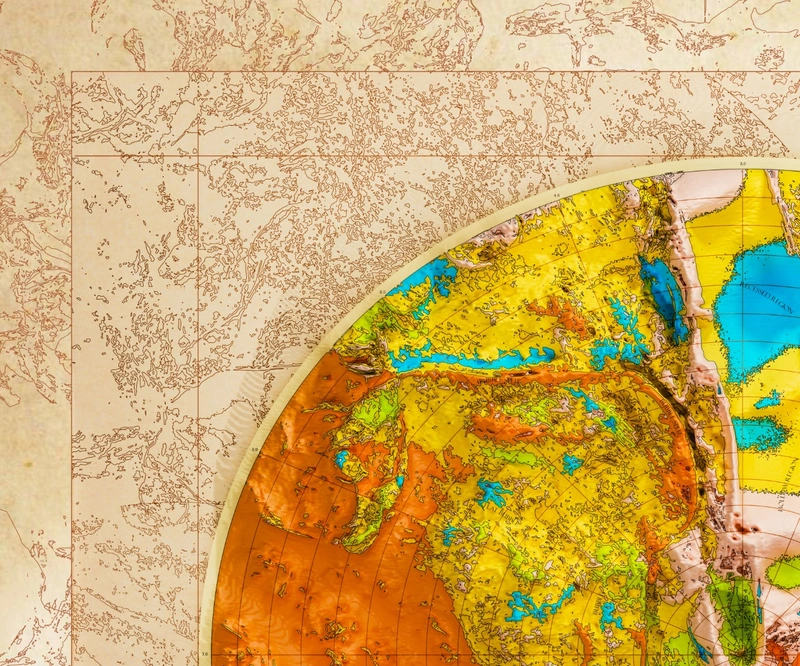
Tracy Naa Koshie Thompson, Two Kanzo World Colliding (detail).
Courtesy of the artist.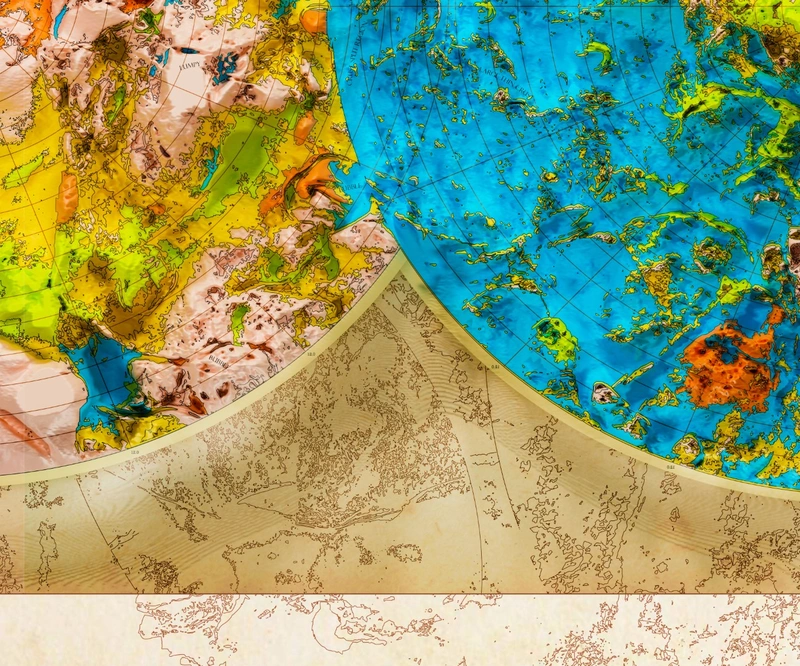
Tracy Naa Koshie Thompson, Two Kanzo World Colliding (detail).
Courtesy of the artist.Producer of the exhibition: International Centre of Graphic Arts (MGLC)
On its behalf: Nevenka Šivavec
Exhibition curator: Patrick Nii Okanta Ankrah
Exhibition management and coordination: Yasmín Martín Vodopivec
Production support: Tajda Tomšič
Educational and accompanying programme: Lili Šturm
Exhibition design: Tracy Naa Koshie Thompson
Public relations: Sanja Kejžar Kladnik
Head of promotion and marketing: Petra Klučar
Design: Ivian Kan Mujezinović / Grupa Ee
Technical and logistics support: Boštjan Vidmar
Accompanying programme
Other exhibitions
Currently on view
