The Oracle in the Words of Chus Martínez: “A wonderful adventure.”
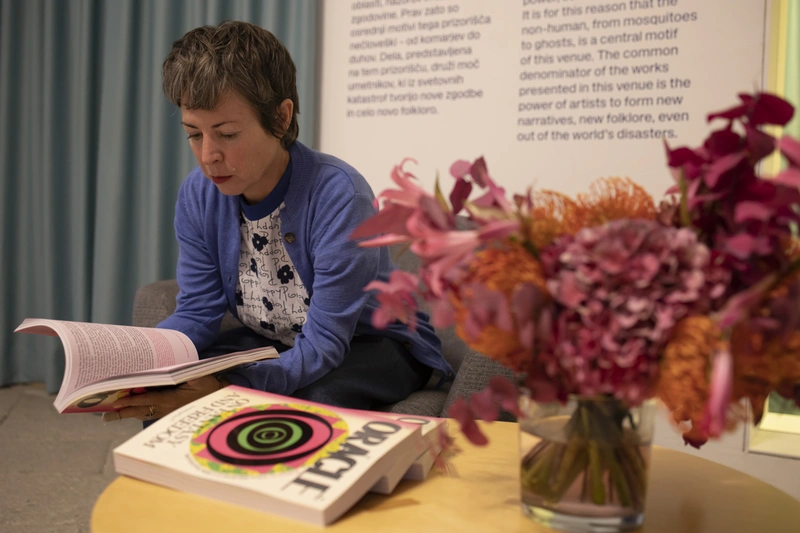
At the end of 2025, the 36th Ljubljana Biennale of Graphic Arts welcomed the book The Oracle: On Fantasy and Freedom, which the artistic director of the most recent Biennale, Chus Martínez, considered to be an integral part of the exhibition itself. In this brief conversation, Martínez shared a few final thoughts on her experience of the Ljubljana Biennale of Graphic Arts.
Browsing the pages of the recently published book, we are at once transported back to the exhibition and immersed in essays by researchers and thinkers, each of whom provides an intriguing insight into the future of democracy. How do the book and the exhibition complement each other?
The book, published by Sternberg Press, is a comprehensive collection of ideas and artworks presented through images and the diaries I wrote for Mousse Magazine before the exhibition. It also expands on the connection and importance of art and culture for the regeneration of democracy through the contributions from the authors including historian Manca G. Renko, philosophers Sadie Plant and Renata Salecl and anthropologists Maja Petrović-Šteger and Svetlana Slapšak.
In creating The Oracle, there were many artists with whom you collaborated for the first time, many of whom presented newly commissioned art projects. There were a lot of unknowns and there was certainly a lot of trust involved in the entire process. Looking back, how would you describe the month of preparations and the moment when The Oracle finally came together?
A wonderful adventure. The structures of our world are collapsing under too many certainties in the wrong places. There is too much pressure to make culture “safe”, while politics and global events remain highly unsafe and unpredictable. When people trust each other, the process is guided by a sense of mutual learning that is normally beneficial and very productive. An exhibition is not only about “presenting” works, but also about producing a sense of discovery that can ignite curiosity and foster new ways of thinking in the art professional.
A number of the artworks produced for this year’s Biennale will live on in other exhibitions and thus continue to make their mark in different contexts. Where will we be able to see them?
Two of them in Madrid: Juan Pérez Agirregoikoa just has his solo exhibition War, Trade and Philanthropy at CA2M, and in March, Yarema Malashchuk and Roman Khimei will also open the solo exhibition Pedagogies of War in the Museo Nacional Thyssen-Bornemisza, organised by TBA21. Gabi Dao's work has been selected for the next Malta Biennale; Nicole L' Huillier's work will be shown in the Schering Foundation space in Berlin in the spring; and Gabriel Abrantes has also been invited to take part in an important group exhibition, yet to be made public. More are to come. In general, the works are finding their way.
From the beginning of your work in Ljubljana, you emphasised the unique position of the city and its Biennale, with its 70-year tradition. Has your view of them changed during the time you have spent getting to know the city and its history from within?
Rather than my view having changed, I would say that I have come to love both even more. The city and the Biennale share almost a century; they nourish each other and together contribute to creating a unique experience for visitors. I must say, for me, this has been one of the most joyful experiences I have ever had.
Interview by Ajda Ana Kocutar.
News